The Business Turnaround: What to Know
A business turnaround is the work of reviving a struggling or failing company — stabilizing the cash, fixing what's actually broken, and putting it back on a path to profit. This guide walks through what a turnaround actually means, what the process looks like, how to run the strategic assessment, and the tactics that carry it out. Where a step can be handled with a ready-made tool or template, we point you to one, so you can move instead of just read.
The principles here come from twenty years of turnaround work and from the research that formalized it. Our angle is simple: the same frameworks a consultant would apply, packaged so you can run them yourself — and if a question outlasts the guide, you can still bring in help.
Understanding the turnaround situation
Most turnarounds share a shape. A business drifts into trouble — sometimes from outside forces, sometimes from decisions made years earlier — and the job is to see the situation clearly, decide what to fix first, and act before the runway disappears. The sections below break that into its parts: the definitions, the process model, the assessment, and the strategies.
What is a turnaround in business?
A business turnaround involves making strategic changes to achieve a positive transformation — moving a company from decline back toward health. It's frequently led by a turnaround manager, an interim professional brought in to steer the recovery, though the underlying work can be run by an owner or existing leadership with the right plan in hand.
What is turnaround restructuring?
Turnaround restructuring — also called corporate restructuring — is the process of reorganizing a company's legal, ownership, operational, or financial structure to relieve distress. Knowing when to trigger it is its own skill; the restructuring-path template lays out how to read your financial position and decide when restructuring is the right move.
How much does a business turnaround cost?
The cost depends on the size and complexity of the organization and how severe the challenges are. Expenses can include hiring turnaround consultants, implementing operational changes, and addressing financial restructuring. The encouraging part: the early diagnostic and planning work — the part that decides everything downstream — can be done in-house with the right frameworks, which keeps the cost of getting started close to zero.
Turnaround business types
Three disciplines cover most turnaround work: change management, turnaround management, and risk management. Change management is planning, implementing, monitoring, and evaluating change across an organization. Turnaround management helps a company execute those changes and meet the challenges of growth. Risk management is identifying, assessing, and controlling the risks tied to a business or investment. A "striking turnaround" — the kind you read about — is simply one of these done efficiently and well.
Identifying common issues and root causes
Turning a struggling business around starts with naming the problem honestly. Once the surface issues are visible, the harder work is digging past them to the root causes. In practice they tend to cluster into a handful of recurring drivers:
- Market changes and shifts in customer preferences
- Poor strategic planning and execution
- Lack of innovation and adaptation to industry trends
- Inadequate risk management and contingency planning
- Insufficient financial management and control
- Weak organizational culture and internal communication
Examining these root causes — rather than treating symptoms — is what lets a business build targeted strategies instead of guessing. For a deeper look at the drivers behind distress, the key elements of a turnaround breaks them down further.
What does the turnaround process look like?
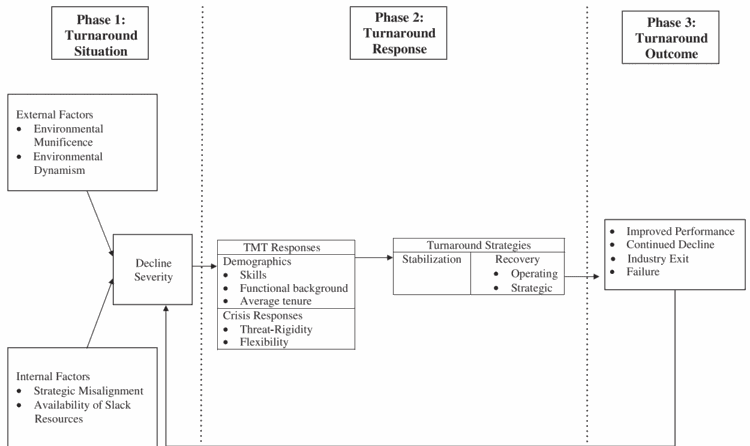
The classic model from researchers John A. Pearce II and Keith Robbins describes the interrelation between retrenchment (stopping the bleeding) and recovery (rebuilding for growth). There are many models, and the right one has to fit the organization — but nearly all of them begin the same way: with a strategic assessment of where the business actually stands. The phases of a turnaround map how a recovery moves from emergency to stability to growth.
Strategic assessment for turnaround
Before changing anything, you need a comprehensive, unsentimental read on the current situation — the finances, the operations, and the outside pressures. If you want to run that assessment on your own business, you can build a turnaround plan for free and work through it step by step. First, though, the overall strategy.
1. Business turnaround strategy
A turnaround strategy is the map back to health: an in-depth analysis of the current situation paired with a concrete action plan. A strong one doesn't just describe the problem — it sequences the fixes so the most urgent, cash-critical issues get handled first. The ten strategy templates give you a starting framework for each recognized turnaround strategy, from financial restructuring to cost reduction to revenue generation.
Company turnaround strategy 101
For a turnaround strategy to actually work, three foundations come first: face the truth and figure out why the company is struggling; concentrate on fixing the most important issues driving those problems; and make sure the right people are in the right positions to help the company succeed. Everything else builds on those three.
What strategy steps should be followed?
Under "face the truth," the work is analyzing your data and financial records for patterns, gathering candid feedback from customers and staff, seeking outside perspective where it helps, and building a prioritized list of challenges broken into manageable pieces. That gives you the evidence to move to the next stage.
Under "fix what matters most," you research the root causes fully, build a detailed action plan with goals, timelines, and owners, allocate financial, human, and technological resources to the priorities, and review progress regularly — celebrating small wins to keep momentum.
Under "right people, right places," you evaluate existing skills to find gaps, provide training where it closes them, hire or reassign to match strengths, and keep adjusting the structure for efficiency. Approach each step with an open mind, ask for support when you need it, and stay committed — confidence comes from doing the work in order.
What are the top turnaround strategies?
The strategies that recur across successful recoveries: financial restructuring, crisis management, increasing sales, boosting profitability, strong leadership, business-process improvements, and cost efficiency. Each maps to specific tactics — the common turnaround questions page works through how they apply in real situations.
2. Analyzing the current business situation
The next step is a thorough evaluation of the existing state of the business — examining the finances, operations, market position, and internal capabilities to build a complete, evidence-based picture. This is the raw material every later decision draws on, which is why doing it honestly matters more than doing it fast.
3. Identifying improvements and opportunities
With the analysis complete, you match the business's key areas against where improvement is possible and where opportunity is hiding. Accurately naming those areas turns the assessment into a roadmap — a sequence of moves rather than a list of complaints.
Transforming a business through turnaround
A turnaround is a vital process that can save a struggling company and set it on a path to lasting success. It isn't a quick fix — it's a long-term commitment requiring strong leadership, effective communication, and disciplined execution. The businesses that come through it treat the recovery as a system to run, not a fire to put out.
How to turn a business around
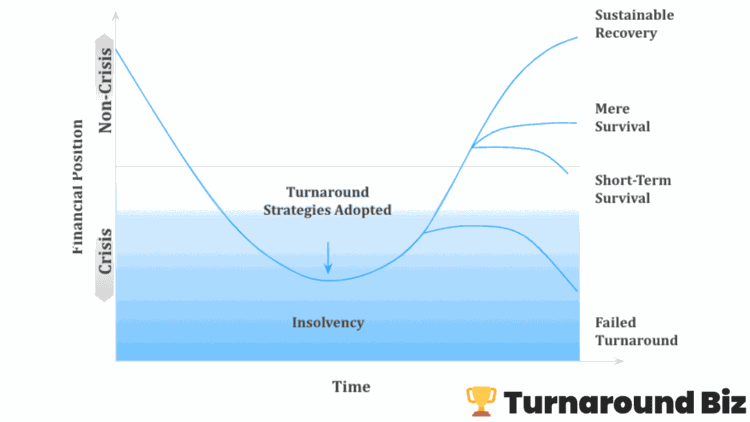
At the core, turning a business around means identifying past points of failure to correct, assessing the current situation and redirecting the company's mission where needed, and taking decisive, data-informed action on the financial problems head-on. For small businesses specifically, the levers are cost reduction, efficiency improvements, better customer experience, and growing revenue — covered in depth in our small-business turnaround guide.
What turnaround-focused services are available?
Turnaround work spans strategic and tactical roles — from turnaround consulting to vendor and supplier negotiations, data analytics, business planning, and marketing support. Increasingly, much of this can be systematized: the recurring, repeatable parts packaged as tools you drop into your own workflow, with specialist help reserved for the genuinely hard calls. That's the model we build toward — the tools handle the repeatable work, and human help is there for what's left.
Who should be on your transformation team?
A transformation team carries out the turnaround, drawn from inside and outside the company. C-suite executives — the CEO and CFO — are common sponsors, with a board member often the next most likely. A turnaround director, a specialist who leads a company back to profitability and stability, is frequently brought in to run the day-to-day of the recovery. You can read how these turnaround professionals are certified and what they do.
Business turnaround support
Support is vital to any organization trying to return to profitability — guidance, resources, and the structure to keep a plan on track. A turnaround consultant helps fix money problems by tackling losses, cash-flow gaps, and the operational issues underneath them. Whether you run the recovery yourself with the right tools or bring in a specialist, the aim is the same: a clear plan, executed consistently. If you'd rather have it handled, our done-for-you support sets up the system and stays on call.
Learning from real turnarounds
Case studies are some of the best teachers here — seeing how a real business faced its obstacles and worked back to stability makes the frameworks concrete. Our collection of business turnaround stories walks through how companies overcame distress and what carried the recovery.
Turning your business around with TurnaroundBiz
There are many ways to approach a turnaround, and that's the point of everything here — to give you the frameworks, templates, and tools to run yours with clarity instead of guesswork. Start where your business is: assess honestly, decide what to fix first, put the plan on paper, and work it week to week. When you're ready to move, the tools are built to do the repetitive parts for you.