Business Turnaround Stories
A dedicated leader and the right strategy can bring a company back from the brink — history is full of proof. Here are real turnaround stories, from famous comebacks you know to the research on what actually separates the businesses that recover from the ones that don't.
Successful vs. unsuccessful turnarounds
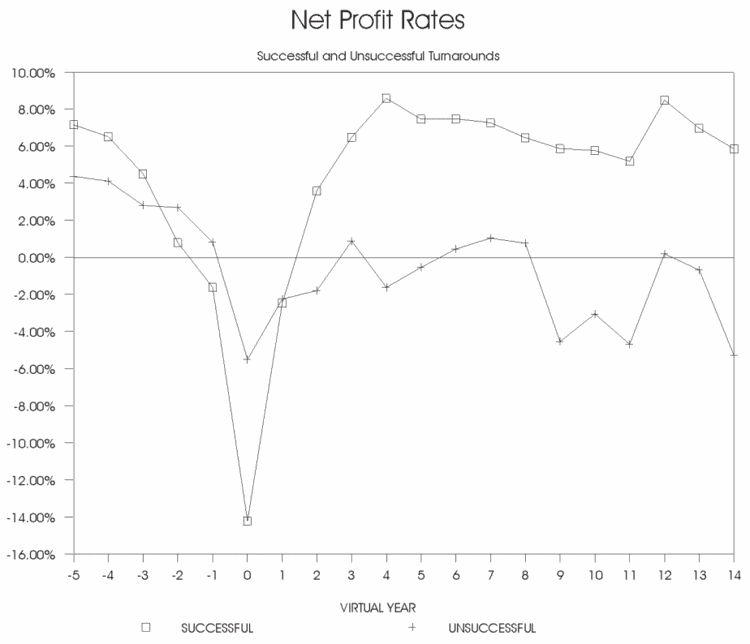
What actually distinguishes a turnaround that works from one that fails? Researcher Frederick M. Zimmerman studied exactly this in The Turnaround Experience: Real-World Lessons in Revitalizing Corporations. Comparing net profit rates across successful and unsuccessful cases, a clear pattern emerges: both start in the same hole, but the successful ones climb back to sustained profitability while the unsuccessful ones stay stuck near or below break-even.
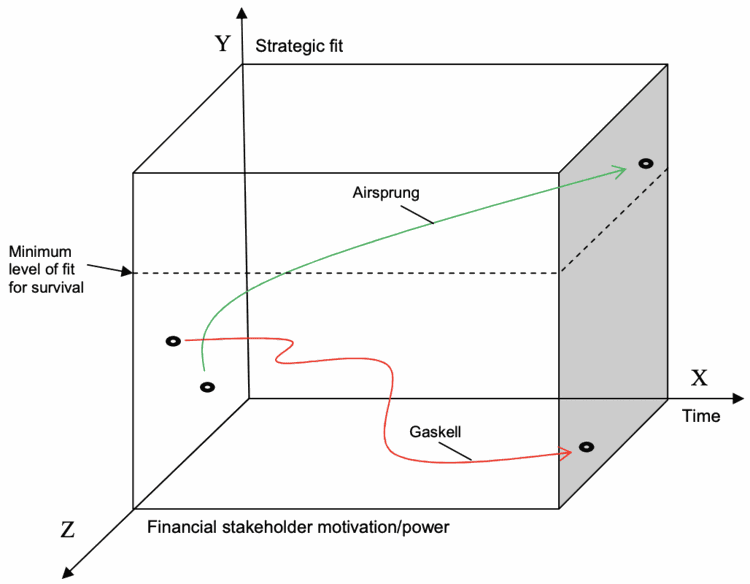
Researcher Ian Roberts, then a doctoral candidate at the University of Manchester, framed it through two companies: Airsprung and Gaskell. Gaskell never reached the minimum level of "fit" a company needs to survive and floundered over time, while Airsprung crossed that threshold and pulled through — a vivid illustration that survival depends on reaching a real threshold of strategic fit, not just effort.
You've likely never heard of those two companies — but the best-known comebacks make the same lessons unmistakable.
Five famous comebacks
1. Apple
In the late 1990s, Apple was on the verge of bankruptcy. The return of Steve Jobs as CEO in 1997 brought a complete overhaul: Jobs discontinued most of the product line to focus on a select few products made exceptional, fostered a culture of innovation, and rebuilt the company around clarity of purpose. That focus — doing fewer things extraordinarily well — became the textbook example of a turnaround driven by strategic discipline.
2. Marvel
Marvel went through a major turnaround in the late 1990s and 2000s. Under CEO Isaac Perlmutter, the company shifted strategy toward licensing its characters for movies and merchandise, and its 2009 acquisition by Disney cemented the comeback. Marvel's story shows how repositioning an existing asset — in this case, a catalog of characters — can be the engine of recovery.
3. Starbucks
Starbucks faced a significant downturn in the early 2000s after growing too fast. Howard Schultz returned as CEO in 2008 believing the company had lost its soul, and led a turnaround that revitalized the brand, refreshed product offerings, and expanded the global footprint through new partnerships. Starbucks regained its position as the leading coffee retailer — a comeback built on returning to core identity.
4. Amedisys
Featured in The Anatomy of a Turnaround by Paul Kusserow, the home-care company was struggling before Kusserow, as CEO, implemented a comprehensive recovery plan. It hinged on rigorous regulatory compliance, strategic acquisitions to expand services and reach, and heavy investment in employee engagement and training. The result was restored profitability and a stronger, more diversified business.
5. eBay
Underperforming in the late 2000s, eBay pursued creative partnerships — including one with General Motors to offer branded domains on eBay.com — as part of its turnaround. Alongside Apple, Marvel, Starbucks, and Amedisys, it's a reminder that comebacks come in many shapes, but they rhyme.
What the comebacks have in common
Seen through the lens of turnaround professionals, these stories share the same handful of moves — the recurring machinery of a comeback:
- Financial restructuring & debt management — Apple's cost-cutting and financial optimization is the classic case.
- Organizational restructuring — Amedisys reorganized for efficiency and clearer accountability.
- Streamlining operations — Starbucks and eBay both sharpened how they ran to lift productivity and profit.
- Marketing & branding to regain presence — nearly every comeback rebuilt its relationship with customers.
These are the same key elements that show up in every serious turnaround — the difference between the famous names and everyone else is disciplined execution, not secret knowledge.
The takeaway
The through-line across every story — the household names and the companies nobody remembers — is that recovery is a repeatable pattern, not luck. Understand the phases, apply the common moves with discipline, and act early. That's what turns a struggling business into a comeback story of its own.