Business Turnaround Questions
A turnaround lives or dies on asking the right questions early. This guide walks through the ones that matter most — from strategy and information to metrics, valuation, and the issues every turnaround eventually runs into — so you can dig into your own situation with a clear head.
Key questions for your turnaround strategy
When crafting a turnaround strategy, a handful of questions frame everything that follows:
- What are the short-term and long-term goals of the turnaround?
- How can the company differentiate itself in the market?
- Are there cost-cutting measures you can implement without jeopardizing core operations?
- Are there strategic partnerships or alliances that could improve your position?
- How will you align the organization's culture with the desired turnaround — and manage resistance to change?
Those cover the operational, financial, and strategic aspects together, with leadership and change management running through all of them. For a broader framing, Tom Lenahan's Turnaround, Shutdown and Outage Management lays out the questions senior management should pose early to minimize disruption:
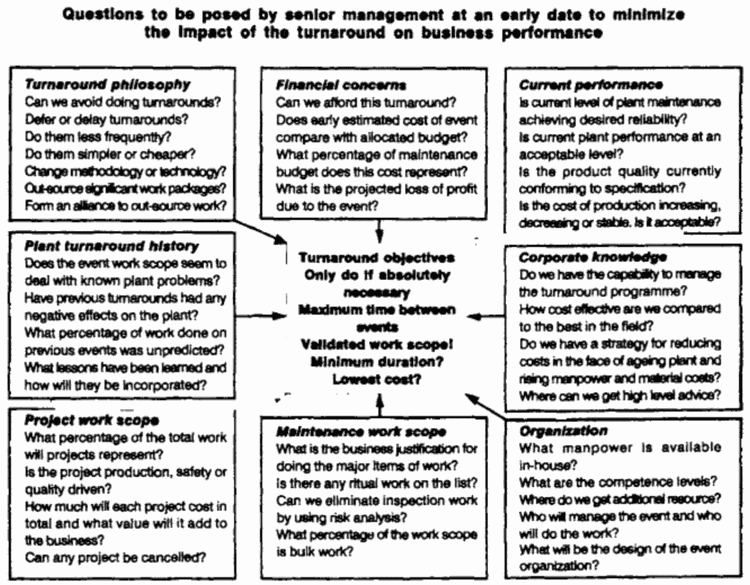
That framework is a baseline — a starting point for digging into your own data. To run your version of it, the free Biz Health Check surfaces your biggest issue in a few minutes.
What information do you need?
Having the right information is what makes every other decision possible. You need a thorough understanding of the company's financial and operational performance, market conditions, and the competitive landscape. That means gathering relevant data and industry benchmarks — internally and through third parties — and using technology to streamline collection and analysis. A turnaround consultant is often the party who assembles and interprets these reports, a point made in the classic article "Information Requirements of Turnaround Managers at the Beginning of Engagements." The analysis phase is where this information-gathering formally happens.
How do you measure progress?
Evaluating turnaround progress through performance measurement is how you know whether the strategy is actually working. Define the metrics that matter up front, set specific targets for each, and track performance against them over time. Ongoing measurement lets you spot what's off track and adjust before small problems compound — which is why consistent reporting matters as much as the initial plan.
Business valuation & asset management
Assessing business value and valuing assets during a turnaround is crucial for understanding the company's real financial state — and for identifying assets that can generate cash flow. In a study from Manchester Business School, researcher Ian Roberts framed company value through its structure, mapping which divisions are viable and which aren't:
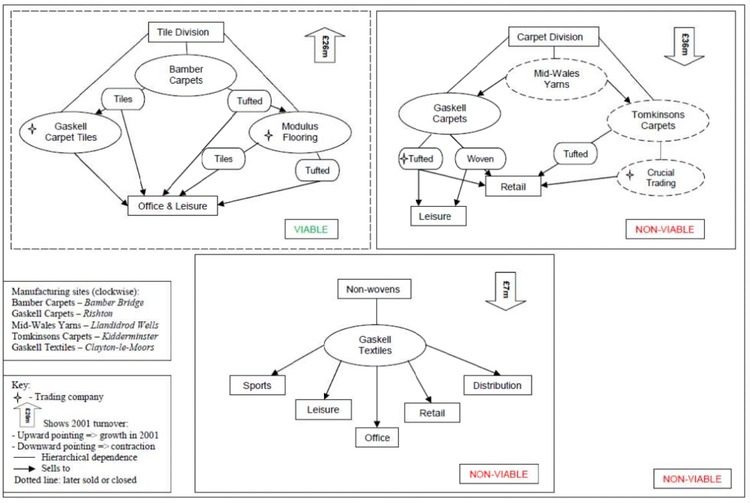
Seeing the business this way — unit by unit — turns a vague sense of trouble into specific, answerable questions about where value is created and where it's draining away.
Business analysis for a turnaround
Thorough business analysis ties the questions together. It comes down to three moves: identifying the key issues, assessing financial health and performance, and analyzing market trends and competition. Done honestly, this analysis is what surfaces the real problems rather than the obvious symptoms — the foundation the whole turnaround is built on.
Common turnaround issues
Most turnarounds run into the same recurring issues — cash-flow strain, misaligned operations, resistance to change, and unclear priorities among them. Recognizing them early, and having a plan to resolve them, meaningfully increases the odds of success. These map closely to the key elements every turnaround has to get right.
Learning from expert experience
Some of the most useful answers come from people who've done it before. The real-life accounts of turnaround professionals — the challenges they hit, the lessons they learned, the strategies that worked — turn abstract questions into concrete guidance. Studying how others navigated the same crossroads is one of the fastest ways to sharpen your own turnaround thinking.
The takeaway
A good turnaround isn't about having every answer up front — it's about asking the right questions in the right order: strategy, information, metrics, valuation, analysis. Work through them honestly and the path forward gets a lot clearer. Start with a free Biz Health Check to answer the first and most important one: where's the biggest problem right now?