Turnaround Meaning in Business
In business, a turnaround is the profitability recovery of a poorly performing company — the strategic and operational process of reversing a decline and returning the business to a self-sustaining, profitable state. This page unpacks the definition, the academic criteria behind it, and where the term actually came from.
Business turnaround definition
Business turnaround refers to the strategic and operational process a company implements to reverse a decline or recover from a difficult financial situation. Whether you're a business owner, an executive, or an aspiring entrepreneur, understanding the concept is essential to navigating and overcoming the challenging periods every company eventually faces. The full playbook behind it lives in our turnaround guide.
What does it mean when a company has a turnaround?
Simply put: a company that had been doing poorly starts to get better — financially and otherwise. More precisely, a turnaround is the process of a company returning to profitability after a period of poor financial performance. But how much improvement, and for how long, counts as a real turnaround? That's where the academic definitions come in.
The operational definitions of "turnaround situation" and "turnaround success" originate with researchers John A. Pearce II and Keith Robbins. Their and others' criteria — spanning consecutive years of earnings decline then recovery, ROI and ROS thresholds, and return to industry-relative performance — are laid out in the scholarly literature:
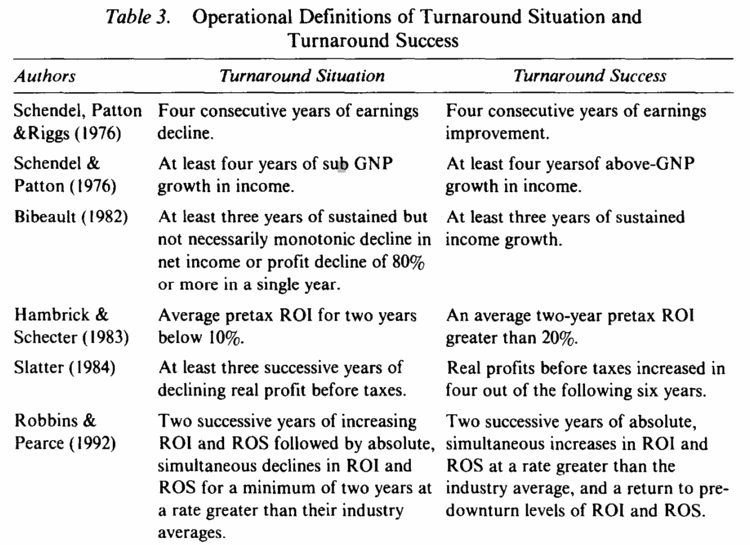
Pearce and Robbins proposed tightening the bar further — that to truly count as a turnaround, a firm's performance during both the decline and the recovery should be measured against its industry, not just in absolute terms. In other words, a real turnaround means genuinely outperforming where the business was heading.
Where the term came from
The business meaning is the common one today, but "turnaround" has been around for centuries. The word was formally added to the dictionary in 1936, meaning essentially "reverse." The Online Etymology Dictionary traces the sense of turning "(something) into (something else)" to 1880s origins, and the business-specific meaning was first recorded around 1939.
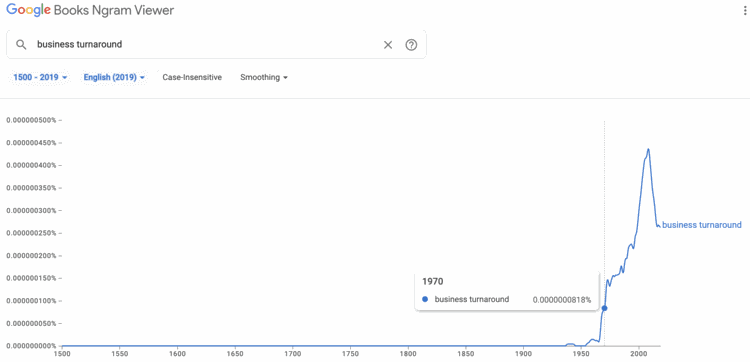
As a business term, "business turnaround" hit critical mass in 1970 — after which it became far more common in books, articles, and research studies, as Google's Ngram Viewer shows:
As the term spread, it standardized into a recognized practice: helping struggling businesses recover became a profession in its own right.
Synonyms & related terms
Corporate turnaround, turnaround management, and business restructuring are all synonyms for the same core idea. You'll also hear "quick turnaround," "dramatic turnaround," and "complete turnaround" — variations that describe the speed or extent of the recovery rather than a different concept.
What is a turnaround company?
A turnaround company is a firm whose business is helping other businesses perform a turnaround. It's hired by CEOs, CFOs, or boards to lead or advise a struggling company back to health — bringing the specialized experience most businesses don't have in-house. You can see what these turnaround experts do, or start with a plan of your own.
The takeaway
A turnaround in business is a complex, multidimensional process — reversing decline and rebuilding a company into a profitable, self-sustaining business through careful planning and disciplined execution. Understanding what it means is the first step; the next is deciding what to fix first. When you're ready, build a turnaround plan for free to map your own recovery.