

In today’s fiercely competitive landscape, a strong and dedicated leader combined with the right strategies can bring a company back from the brink of failure to soaring heights of profitability. By examining real-life business turnaround stories, we uncover valuable lessons and insights that can help you navigate the challenging journey of reviving a troubled enterprise.
At TurnaroundBiz.com, we have seen the good, bad and ugly when it comes to business turnaround attempts. That’s why we want to enlighten you on some of the remarkable stories of recent times involving business turnarounds. With over 20 years of combined management experience of turnarounds and entrepreneurship, our team of consultants see these stories continue to inspire clients and we offer them to you in this guide for free.
Lets fist take a look at the difference between success and failure with turnarounds using real company examples.
Successful vs Unsuccessful Turnarounds
According to a study by University of St. Thomas researcher Frederick M. Zimmerman in The Turnaround Experience: Real-world Lessons in Revitalizing Corporations, company turnarounds were analyzed further first starting with their success rates judging on a pass-fail basis, as shown below.
| Successful Turnarounds | Unsuccessful Turnarounds |
| Buick (1906 – 1925), Jeffery Motors (1911 – 1930), American Motors Corporation (1951 – 1970), Ford Motor Company (1975 – 1988), Cadillac (1897 – 1916), Chrysler Corporation (1975 – 1988), Maxwell-Chalmers (1916 – 1935), Packard (1929 – 1948), Deere & Co. (1927 – 1946) | International Harvester (1966 – 1985), Willys-Overland (1916 – 1935), Kaiser-Frazer (1944 – 1956), Hudson Motor Co. (1927 – 1946), AMC/Renault (1971 – 1987), Allis-Chalmers (1963 – 1935), Studebaker-Packard (1949 – 1966) |
Of the cases from the study above, the graph below shows what separates successful vs unsuccessful turnarounds is shown from a net profit rate standpoint.

In a perspective from researcher Ian Roberts, when he was a doctoral candidate at the University of Manchester, he stated two companies with one successful and the other not successful in their turnarounds are shown in the figure below:
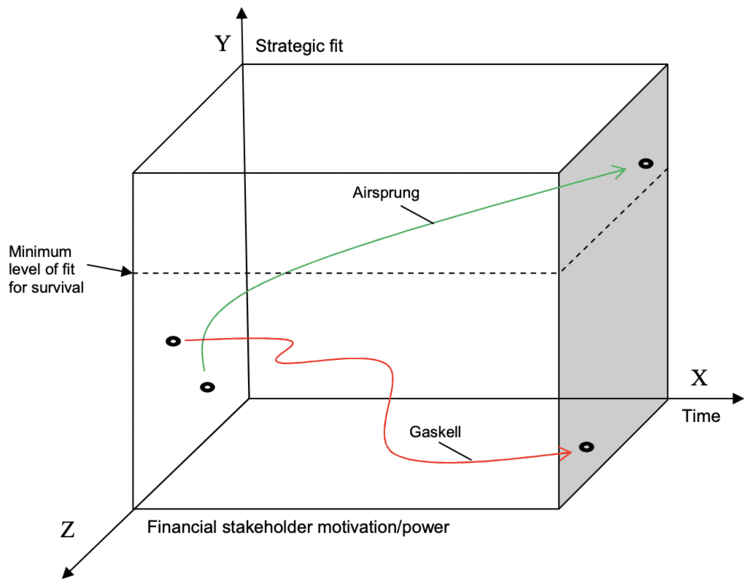
In the example above, Gaskell hadn’t met the minimum level of fit for survival as a company and floundered over time, while the Airsprung business turnaround became a success.
Now, you probably never heard of those companies, but the best comebacks you may have which we’ll cover next.
Top 5 Best Turnaround Comebacks
The Corporate Turnaround Stories of the past few years have showcased incredible resilience and strategic thinking. These companies were able to overcome significant challenges and turn their businesses around, resulting in remarkable success. Here are the top 5 best turnaround comebacks:
1. Apple
In the late 1990s, Apple was on the verge of bankruptcy. However, with the return of Steve Jobs as CEO and a focus on innovative products like the iPod and iPhone, Apple made a remarkable turnaround and became one of the most valuable companies in the world.
With Steve Jobs returning as the CEO in 1997, Apple witnessed a profound transformation. Jobs recognized the need for a complete overhaul and began implementing radical changes throughout the organization.
In the late 1990s, Apple Inc. faced numerous challenges that threatened its very existence. The company was struggling to compete in the rapidly evolving technology industry and its market share had plummeted. However, under the leadership of Steve Jobs, Apple embarked on a remarkable turnaround journey that changed the course of its history forever.
Under Jobs’ leadership, Apple focused on fostering a culture of innovation and excellence. He believed in pushing boundaries and empowering employees to think differently. Jobs surrounded himself with top talent and encouraged collaboration and open communication.
One of the key factors in Apple’s turnaround was the decision to focus on a select few products and make them exceptional. Jobs discontinued underperforming product lines and streamlined Apple’s portfolio to prioritize groundbreaking devices such as the iMac, iPod, iPhone, and later, the iPad.
Clear communication, motivation, and effective team-building were crucial turnaround elements in Apple’s turnaround. The company invested in frequent communication channels, including regular team meetings and town hall sessions. This transparent approach fostered trust and alignment within the organization.
2. Marvel
American company Marvel, known for its iconic comic book characters like Spider-Man and Iron Man, went through a major turnaround in the late 1990s and early 2000s. At the time, Marvel was struggling financially and had filed for bankruptcy in 1996.
Under the leadership of CEO Isaac Perlmutter, Marvel implemented a new strategy focused on licensing its characters for movies and merchandise. This strategy proved to be a game-changer for the company. Marvel started producing its own movies, beginning with the release of “Iron Man” in 2008, which was a huge success.
Marvel’s turnaround can also be attributed to its successful partnership with Disney. In 2009, Disney acquired Marvel Entertainment for $4 billion, providing the company with financial stability and access to new resources.
3. Starbucks
A business comeback by a company we all know, Starbucks faced a significant downturn in the early 2000s. The company had grown rapidly but had also become stagnant and lost its focus on customer experience. As a result, Starbucks experienced declining sales and store closures.
In 2008, Howard Schultz returned as CEO of Starbucks and initiated a turnaround plan. Schultz believed that Starbucks had lost its soul and needed to reconnect with its customers. He closed underperforming stores, retrained employees, and refocused on delivering an exceptional customer experience.
Schultz also made significant changes to Starbucks’ product offerings. He introduced new beverages and food options, revitalized the brand’s image, and implemented environmentally friendly practices.
In addition to these internal changes, Schultz focused on expanding Starbucks’ global presence. He strategized partnerships with grocery stores and other retailers to increase Starbucks’ distribution channels and reach a wider audience.
Through these efforts, Starbucks was able to successfully turn its business around and regain its position as a leading coffee retailer. The company experienced significant growth, opened new stores, and saw an increase in customer satisfaction and loyalty.
4. Amedisys
As featured as the company turnaround in The Anatomy of a Turnaround by Paul Kusserow, the home care juggernaut that we know today had a challenging period in its history. Amedisys, a provider of home healthcare services, faced financial troubles and regulatory scrutiny in the early 2010s.
Under the leadership of CEO Paul Kusserow, Amedisys implemented a comprehensive turnaround plan to address these issues and restore profitability. The company focused on improving operational efficiency, reducing costs, and enhancing patient care.
A key aspect of Amedisys’ turnaround was its commitment to regulatory compliance. The company implemented robust compliance programs and invested in training to ensure adherence to regulations and best practices.
Amedisys also made strategic acquisitions to expand its service offerings and geographic reach. This allowed the company to diversify its revenue streams and strengthen its position in the home healthcare industry.
Additionally, Amedisys prioritized employee engagement and satisfaction. The company invested in training and development programs for its employees, recognizing their importance in delivering high-quality patient care.
Through these efforts, Amedisys was able to successfully turn its business around. The company experienced improved financial performance, increased patient satisfaction, and regained investor confidence.
5. eBay
Underperforming in late 2000s, eBay collaborated with General Motors to offer branded domains on eBay.com as a part of their turnaround strategy. Experiencing -29% profit two quarters in a row, as researcher Fred R. David said in “Strategic Management Concepts and Cases” textbook on eBay, he said, “The company continued its turnaround strategy in a harsh climate for consumer spending.” This also lead to the IPO of eBay-owned Skype and Paypal.
eBay, Starbucks, Amedisys, Marvel and Apple are just a few examples of companies that have successfully turned their businesses around. These stories serve as inspiring reminders that with the right leadership, strategic planning, and commitment to change, it is possible to overcome challenges and achieve success.
Commonalities of Comebacks
Through the lense of turnaround professionals, business turnarounds share many commonalities in how they actually turnaround their fate and comeback which include: financial restructuring, organizational restructuring, streamlining operations, improved marketing, and/or enhanced innovation capabilities. Below we cover some of the standouts in each common group which is attributed to how they survived and began to thrive after using the particular techniques.
To comeback from no-man’s land to prosper among the titans, business turnarounds typically turnaround by applying:
Financial Restructuring and Debt Management Techniques
One of the first steps in a turnaround is to address the financial challenges of a company. After doing so through executing the recommended actions, the companies in trouble are able to reduce its debt burden and create a more sustainable financial foundation.
Apple underwent significant financial restructuring to regain stability. The company implemented cost-cutting measures and optimized its supply chain to achieve better operational efficiency. This allowed Apple to reduce production costs and increase profitability. To overcome its financial challenges, Apple leveraged various debt management strategies and successfully raised funds through bond offerings. These actions provided the company with the necessary resources to drive innovation and fuel its growth.
All of this is attributed to financial restructuring. Another method to restructure though is at the organizational level.
Organizational Restructuring Initiatives for Improved Efficiency
Recognizing the need for a streamlined and efficient organizational structure may require undertaking a comprehensive reorganization effort. These efforts can require careful evaluation of the company’s structure, hierarchy, and departments. By eliminating redundancies, clarifying roles and responsibilities, and improving communication channels, companies can achieve significant gains in operational efficiency.
An example is Amedisys in this case. All of this is attributed to organization restructuring.
Streamlining Operations to Enhance Productivity and Profitability
To improve productivity and profitability, you may need to implement measures to streamline operations. This might include optimizing supply chains, enhancing manufacturing processes, and improving inventory management. By eliminating inefficiencies and bottlenecks, companies are able to maximize output and improve its bottom line.
Some examples of companies that did turnaround because of this include Starbucks and eBay. All of this is attributed to streamlining operations.
Marketing and Branding Strategies to Regain Market Presence
To regain market presence and rebuild a profitable brand, companies may need to implement a comprehensive marketing and branding strategy. This can involve repositioning the brand to target new markets, enhancing marketing campaigns, and improving customer relationships.
Apple revamped its marketing and branding strategies to create a distinct identity in the market. The company focused on promoting the seamless integration of hardware and software, emphasizing user experience, and showcasing its products as desirable lifestyle choices. Apple redefined its target markets by expanding beyond the traditional tech-savvy consumer base. The company targeted everyday users and businesses, highlighting the simplicity and functionality of its products. Apple also invested heavily in marketing campaigns, unveiling iconic ads that captivated audiences worldwide. Apple demonstrated a remarkable ability to adapt to evolving market trends. The company recognized the potential of new technologies, such as cloud computing and wearable devices, and quickly integrated them into its product offerings. This adaptability allowed Apple to stay ahead of the competition.
Innovation and Change Management for Adapting to a Dynamic Market
Recognizing the need to adapt to a rapidly changing market, a company may need to prioritize innovation and change management. By fostering a culture of continuous improvement and embracing new technologies, companies are able to stay ahead of the competition and meet evolving customer needs. This commitment to innovation can play a significant role in the company’s successful turnaround.
Apple leveraged innovation to enhance customer relationships and loyalty. The company consistently introduced groundbreaking features, software updates, and ecosystem connectivity, keeping customers engaged and excited about its products. Innovation and change management were central to Apple’s resurgence. The company embraced emerging technologies, such as touchscreen interfaces and app stores, setting the stage for future success. Apple’s ability to adapt quickly to market changes and drive innovation became a key differentiating factor.
Though each company is unique any may be in various stages of the turnaround process, each organization enjoyed champagne moments as they accomplished a comeback which would pay-off for the company in the long-run.
Are you ready for your comeback?
While the strategies employed by the companies above were successful for their respective industries and regions, it’s important to note that not all strategies are universally applicable.
Each business sector and geographical region presents its own unique challenges and opportunities. That’s why it is crucial for businesses to tailor their turnaround strategies to fit the specific needs and requirements of their specific business. To get started, you can start your business turnaround plan now at no upfront cost.
Business turnarounds are complex endeavors that require a comprehensive analysis of the underlying issues, thoughtful strategy development, strong leadership, and perseverance. By learning from the successes and challenges of companies, businesses can gain valuable insights and inspiration to navigate their own turnaround journeys.