

Let’s delve into the various phases of business turnaround, providing you with valuable insights and steps that will help you navigate the path to success in your turnaround.
For over 20 years combined, the leadership team at TurnaroundBiz.com has prided itself in offering white glove service to clients in need of a turnaround in their business, and we’ve helped them to not also survive– but also thrive!
As we dive into the phases of a business turnaround and equip you with the knowledge and strategies to turn your business around, consider how this all can help in your situation.
When it comes to phasing processes throughout a turnaround, our approach is below as found with the business turnaround templates, freely available to download and customize for your business.
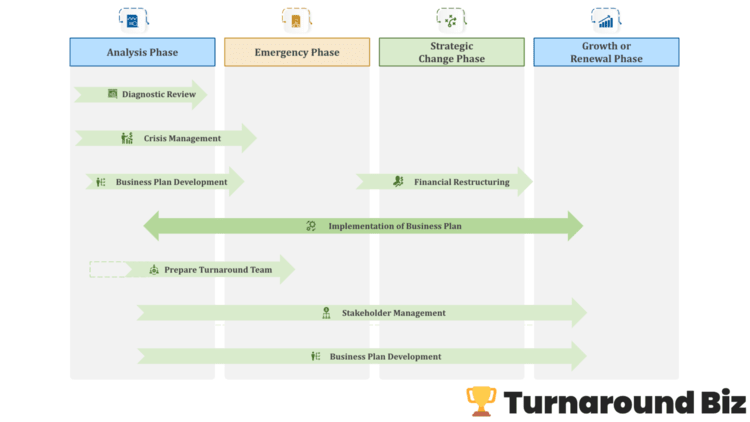
4 Phases of a Business Turnaround
Some organizations train the stages as “assess, triage, stabilize, turnaround and growth”, but we teach to get right down to brass tacks: the phases of the turnaround itself.
The process of business turnaround involves several key phases that are crucial for successfully revitalizing a struggling company. Each phase focuses on different aspects of the turnaround process, ensuring a comprehensive approach to restore the business’s viability.
1st: Analysis Phase
The first phase of a business turnaround is the analysis phase. This phase involves conducting a thorough assessment and analysis of the current state of the business.
During this phase, it is essential to gather all relevant data and information about the company’s financials, operations, market position, customer base, and competitive landscape.
2nd: Emergency Phase
Once the analysis phase is completed and a clear understanding of the current state of the business is established, the next phase in the turnaround process is the emergency phase.
During this phase, immediate actions are taken to address any urgent issues that threaten the survival of the business. This could involve cost-cutting measures, such as reducing expenses and eliminating non-essential activities or services.
3rd: Strategic Change Phase
After addressing the immediate threats in the emergency phase, the strategic change phase of a business turnaround focuses on implementing long-term strategies to reshape and reposition the company. This phase involves making significant changes to the business’s overall strategy, structure, and operations.
In this phase, it is crucial to identify and address any underlying issues or weaknesses that contributed to the company’s decline.
4th: Growth/Renewal Phase
The final phase of a business turnaround is the growth/renewal phase. Once the necessary changes have been implemented and the company is on a path to stability, this phase focuses on driving growth and renewing the business’s competitiveness in the market.
During this phase, efforts are made to expand the customer base, increase sales and revenue, improve profitability, and ensure long-term sustainability.
The phases of a turnaround are simple now that you know what to expect when everything unfolds working with turnaround pros.
What other aspects do experts consider?
The virtuous cycle of the phases, according to researcher Ian Roberts at University of Manchester, fuel and feed into each other as shown in the diagram below:
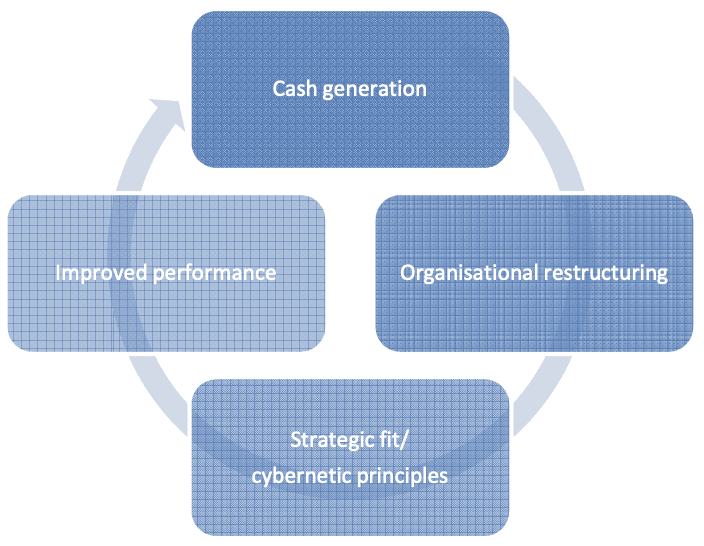
Cash generation feeds into organization restructuring which feeds into strategic fit / cybernetic principles which fuels improved performance leading back to more cash generation, according to the model Roberts published in 2015.
Before then in 2004, researchers Franz T. Lohrke, A. Bedeian, Timothy B. Palmer wrote the phases as 1) Turnaround Situation, 2) Turnaround Response and 3) Turnaround Outcome, as described in the image below from their “The Role of Top Management Teams in Formulating and Implementing Turnaround Strategies: A Review and Research Agenda” article published in the October edition of International Journal of Management Reviews.
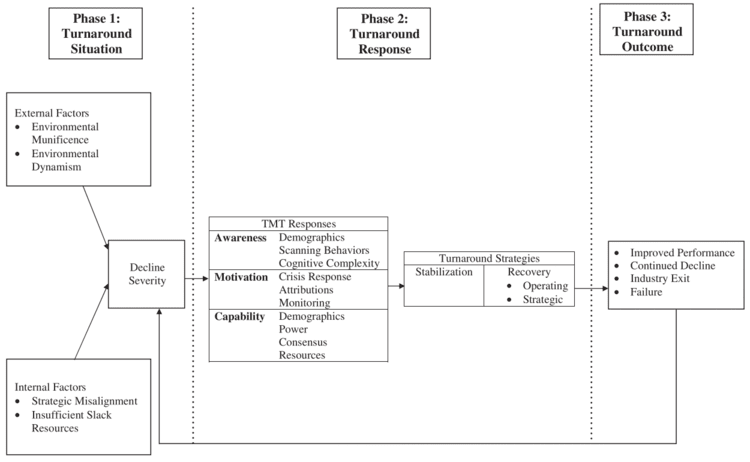
The turnaround management process shifts in focus from one phase to another. The turnaround phase actually begins by assessing the current situation accurately.
What are the stages to a business failure?
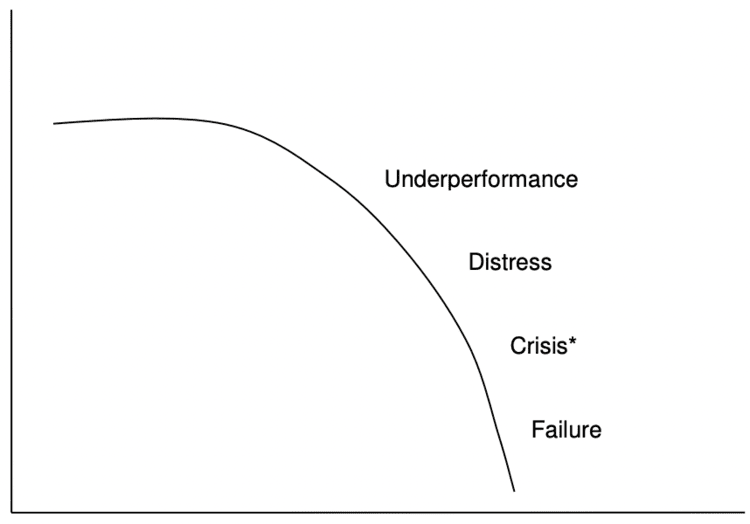
The stages to business failure start with underperformance leading to distress turning into a crisis before turning into a failure, according to researcher Gabriela Golumbovici in her 2008 paper titled Turnaround in Small and Medium Size Enterprises for the Oxford Brookes University.
There she describes the slippery slope to failure as the following:
Are you ready to start the first phase of a turnaround?
For businesses struggling, we offer the option to get started with a business turnaround planning tool for putting the thoughts and figures together before speaking with a turnaround expert.
It asks the basic business turnaround questions you’d expect on a form like that, though also helps you to tease out some of the hidden truths if you weren’t asked so directly. All in efforts to help run the turnaround smoother. Helpful for business owners, CEOs, CFOs, Board Members, etc, and asked in a way that’s not as confrontational as it’d be of being asked by a junior employee at other firms asking too much and getting in your business!
Business turnaround strategies require thorough business turnaround analysis before recommending a strategy with a high-level of confidence in its success probability. That’s why
To start the company turnaround strategy, fill-in your company’s details using the free online business plan resource to get started today.
Note: effective turnaround execution requires taking an objective approach to quickly move along with assignments while navigating the unknowns during a turnaround. That’s why a turnaround firm like ours exists– so if you need to know where to get a turnaround specialist — now you know!
Putting it Together
The phases of business turnaround require a strategic approach to address the challenges and revive a struggling business. It is crucial to assess the situation, identify key areas for improvement, and implement effective strategies.